
Encounters in the temple
Welcome to "Encounters in the temple". Materials are modified from the longer retreat for the Sisters of St. Martha in Antigonish by Fr. Tim in May 2025.
Join in a flexible experience of daily prayer and reflection. Choose to commit to a regular period of prayer each day, or start with only one day a week. Use as much or as little of the material as helps you in your spiritual journey.

The temple... Place of Glory
We wanna begin today by just thinking about the temple, where encounters take place.
As you can read from the Gospel of Luke, chapter 2, Mary and Joseph brought the child to the temple to present him to the Lord.
And as we're thinking about this, we wanna think about this is the temple, this is the temple that God has created. It is you, it's your body, it's who you are. You are a temple yourself.
So have that in the back of your mind as you think about this presence of God in the temple. And that's what set the temple apart, what made the temple dear to Israel, was that's where the glory of God was to be found. The glory of God was located in the temple. And it was what made Israel, Israel. If the glory of God was absent, Israel was no longer Israel.
And we remember absent, Israel was no longer Israel. And we remember how God accompanied Israel in the desert. But, and you know all this stuff, I'm just telling you stuff you already know. Right? Cloud by day, pillar of fire at night, accompany Israel through all her trials until David built the temple, and then the glory of God occupied the temple.
That's our story of salvation. Until it didn't. Do you remember from our scripture courses how the temple was destroyed, the exile takes place, and there's a line in the prophet Zechariah, it describes how the glory of God left the temple. So the glory of God abandons the temple, never to return until this moment. So for all those hundreds of years, the glory of God has not returned to the temple until the day that Mary and Joseph bring the child, Jesus, to the temple.
And there's something strange about this, because the Glory of God comes back to the temple as a little baby. A helpless, incompetent baby. As a tiny baby. Now what you and I, and maybe not so much you and I, but the world around us, when it thinks about glory, it tends to think about big events. It tends to think about great achievements.
The Oilers are trying to win the Stanley Cup, that'll be glory in Edmonton, if that happens. It's gonna be a big achievement and Canada will all rejoice. That's glory. Glory is a big event on a huge scale, great triumph. And even in the course of our own lives, we can point to moments of glory, you know, when we completed a program in a parish and it was great success and people are patting us on the back, and well done Sister, that was great, I really enjoyed that.
We have that sense, this is the glory of God. Cause we weren't doing it for ourselves, we were doing it for God. This is the glory of God, we've accomplished this. Or we have some kind of Lenten program or something. We finished the Lenten program, everybody said, That was great, that was wonderful, the glory of God.
So we have that sense that the glory of God is attached to great big events. And then we come to this point in our life, and I share this with you because even though the bishop keeps thinking I'm a young priest and I can do his job, I look around at all these young priests in our diocese who are running the diocese and renewal now, they've done the big surveys in the parish, and now they're preparing their pastoral plans to implement the renewal in the parish. And and I'm kind of on the beach, you know. And it's tempting to look at that and say, well, I guess the glory of God has left the temple of my life, you know. It was always sort of tempting to think like that and say, well I guess my glory days are over.
You know, my wonderful days of achievement and accomplishment. And now there's nothing left. My life is empty of the glory of God. Pretty tempting to kind of drift along those lines. That's why we have today's picture to reflect on.
We have this photograph and it's a photograph of a model of the Ark of the Covenant. I'd never seen this before. It was the first time I'd ever seen a kind of a model of what it looked like. Have you got that in your little book list? That's that little gold kind of [box]. So, apparently this is constructed according to the details that are found in the Old Testament.
What did the Ark of the Covenant look like? Well, apparently it looked like this, apparently. And inside was Moses' staff that he used to separate the waters of the Red Sea. The tablets with the 10 commandments, and some manna. The food.
That was inside the box. And then the top of the box is called the mercy seat. And in the Old Testament, it describes the place of God's glory was between the wings of the Seraphim on top of the box. See the wings? Yeah.
See that little space in between the wings? Israel imagined that the entire glory of God was contained in that tiny little space. Kind of a kind of a amazing when you think about it. You think the glory of Gog would at least need a room this big, you know. Like I didn't at least need a castle to be contained.
The glory, it needed a big space, you know, a stadium maybe, a huge space, you know. It needed McMahon Stadium or some great big area to contain the whole glory of God. The whole immense weight of God. But Israel pictured, No, the glory of God rested on the mercy seat in the space between the wings of the Seraphim. And I love that image because it's a declaration that the glory of God doesn't need to be a big thing.
The glory of God doesn't need to be a huge achievement. In fact, just the opposite. The glory of God appears in emptiness, and smallness, and weakness. Why does God appear in weakness, and emptiness, and poverty? Well, the reason God does that is because God doesn't need to prove himself.
If God had to bowl us over, if God had to beat us, God would be a competitor with us. God would be like us having to prove that we are important. God would be like us having to win people over. God is not like us at all. God doesn't have to defend himself.
God doesn't have to prove himself. God doesn't have to bowl anyone over. God is God. The immensity of God. And the best way, the only way to show how different God is from us is to do the very opposite of what we do.
We try to be strong and powerful and show how glorious we are by our achievements. God does exactly the opposite. Says, I'm gonna show you how different I am from you. I'm gonna appear like a baby instead of a strong man. I'm gonna appear in weakness and frailty instead of power and majesty because I don't need to prove myself.
I don't need to knock people over. I don't need to show people who I am and how powerful I am. And we have the most dramatic demonstration of that at the crucifixion. You remember, Christ is dying on the cross and the crowd say to him, If you are God, what did they say? Come down from the cross.
Come down from the cross. Say it yourself, prove it. Prove it. And we say, well I guess he was too weak to do it. No he wasn't.
He could have done, he could have easily done that. He doesn't do it because God doesn't prove himself. God doesn't have to be powerful, overwhelming. God is so different that God doesn't have to bold people over, doesn't have to demonstrate. And we sometimes forget that because we tend to think glory is about big achievements and big accomplishments.
No, it's about a tiny baby who's incompetent, helpless. And that exists in our life. Thomas Merton says that inside every human being is a place of pure divine emptiness, created by God. Nothing can occupy that space except God. Nothing can destroy that space.
Nothing can harm it. Nothing can take it apart. Nothing can dismantle it. Inside every human being is a pure, divine, perfectly empty space that is the power and glory of God. And it contains the immense majesty and weight of God present in every human being's heart.
Imagine this, we are always reacting to what the world is saying. We're always trying to prove ourselves, trying to do what other people think we should be doing. If we could act purely out of that one tiny divine emptiness, we could dislodge the earth from its orbit. Because that's how powerful that is. We can never do it because we're not pure, right?
We're not perfect, we're not holy, we're not. But if we ever could, that's why Jesus says, if you had the faith of a mustard seed, you could move a mountain. If you could act purely out of that emptiness, out of that divine little place inside your heart, if you could do one thing that was not motivated by a desire to impress, a desire to prove yourself, a desire to get back at somebody. If you could act out of that pure little thing, you could move a mountain. So I thought today it would be a good day to spend a little bit of time imagining yourself sheltering under the wing, you know?
We'll sing that refrain before we finish here about that. Under the wing of God, the mercy seat, where the glory of God dwells. And when you look at that picture today, that photograph, think about the fact that that glory of God that Israel imagined to be resting between the wings of the seraphim, that glory of God is in you. Nothing can touch it. Nothing can destroy it.
You don't have to prove yourself. You don't have to be magnificent. All we have to do is to try to act out of that one little space inside of us that's pure God. And when we do, we move mountains. I love that image.
The glory of the cloud is not immense, it's small. You don't have to prove yourself. You don't have to demonstrate who you are. You contain the divine spark of God hidden inside of you. And you can act out of that divine spark, and you can move mountains.

Encountering the stranger
Singing...
Give ear, oh my people, to my teaching. Incline your ears to the words of my mouth. I will open my mouth in a parable. I will utter dark sayings from of old. We will not hide them from their children.
We will tell to the coming generation the glorious deeds of the Lord and his might and the wonders that he has done. In the sight of their ancestors, he worked marbles in the land of Egypt, in the fields of Zoan. He divided the sea and let them pass through it, and made the waters stand like a heap. In the daytime, he led them with a cloud, and all night long with a fiery light. He split rocks open in the wilderness and gave them drink abundantly as from the deep.
He made streams come out of the rock and caused waters to flow down like rivers. They tested God in their heart by demanding the food they craved. They spoke against God saying, can God spread a table in the wilderness? Even though he struck the rock so that the water gushed out and torrents overflowed, can he also give bread or provide meat for his people? Yet he commanded the skies above and opened the doors of heaven.
He rained down on them manna to eat and gave them the grain of heaven. Mortals ate of the bread of angels. He sent them food in abundance and ate and were filled. So we gave them what they craved. Then he let them led out his people like sheep and guided them in the wilderness like a flock.
He led them in safety so that they were not afraid, but the sea sea overwhelmed their enemies. And he brought them to his holy hill, to the mountain that his right hand had won. He drove out nations before them. He apportioned them for a possession and settled the tribes of Israel in their tents.
Thank you. Good morning and welcome. So we began by thinking how encounter is key to our journey of faith. And if we look back at our life of faith, we would be able to mark it by different encounters that have taken place.
And then, yesterday we talked a little bit about the temple, about we are this temple and the temple, the glory of God contained in the temple and in us is not huge and large because God does not have to prove himself. Doesn't have to demonstrate his power. But there is in each one of us a pure place of, Thomas Merton calls it complete emptiness because that's the only way to describe the power of God. And if we could ever act out of that single pure emptiness, we could move mountains. Love that image.
So we're going to talk a little bit about today about encounters in the temple, and we're going to talk a little bit about the encounters with strangers. In some ways that's because I think that's where we find ourselves as a church today. You know, you and I grew up and saw a change from having complete confidence that we knew and possessed the truth. We were Catholics, and God was with us and we had all the answers and we could with confidence teach catechism and live our faith and we just took all that for granted. And in our lifespan, we've moved from that experience to one of uncertainty and hesitancy and insecurity, you know.
At least I find that true for myself when I think about that. We went from absolute certainty about who we were, where we came from, who was in charge of the world, to all kinds of questions and doubts about those realities. I think that's a huge transformation that's taken place and in a very short period of time, but it was building up over a very long period of time.
So think about this for a minute, that from the time of Jesus's death and resurrection to four/fifteen hundred years - it's quite a chunk of time - we believed that the Earth was the center of the universe. That was, that's, we were absolutely convinced about that.
We believed that everything that moved in the world, every object that moved, everything that happened was directly caused by God. That God had all the power and God caused everything to happen. And we also believe that God had created us as a stand alone, unique creature unlike any other creature at all. We believed those three things for fifteen hundred years. Amazing.
Thomas Aquinas believed those things. All of the great teachers believed those things. The great Saints believed those things. And look what happened in six or three or four hundred years. So fourteen hundred AD, Copernicus helped us to discover that we were not the center of the universe, but the sun was.
And we revolved around the sun. That's 1400. In 1600, Newton discovered the laws of gravity. What caused things to fall like apples from the tree? Not God. Gravity. And in 1800, Darwin published his book on the origin of the species and we suddenly came face to face with the fact that we had evolved. We were somehow connected with all other living creatures. Just think about those three incredible changes that took place. 1400, Copernicus told us we didn't we were not the center of the universe, which helped us to believe that God really thought we were really important.
But we were this dusty little planet. Not particularly wonderful. And around us were a billion other planets. And we lived and we slowly come to realize this universe of ours is 13,000,000,000 years old. And this Earth that we live on is 6,000,000,000 years old.
And human beings have been living on this planet for some sixty thousand years. All of those discoveries really rattled us. And then Newton came along with the laws of physics and we realized God didn't cause things to move, nature did. And now we are struggling with quantum physics which tells us that the world is not made up of tiny little objects that bump into each other, but it's made up of energy. And energy can be anywhere.
Energy just flows. And energy is inside of us, it's in creation, and it flows back and forth. It's not particles, it's movement and power. And then of course Darwin came along and all of a sudden we were faced with evolution and not just biological evolution as Desjardins and others have taught us, but the evolution of consciousness, of awareness. Those are all those realities.
And I think together that combination, it kind of unseated us as a church. It made us less confident, less sure because all of a sudden we weren't sure where we came from and we weren't sure who made us and we weren't sure what caused things to happen in the world. So all of a sudden doubt entered into our church in a big way. And we struggled with that. We had real difficulties with evolution for quite a long period of time.
And we still have difficulties talking about how creation has come to this point in this existence. When I'm preaching, I always keep trying to make mention of the fact that the Earth is 6,000,000,000 years old and just before Christmas, the James Webb Telescope, which is floating way out in space, it took a picture of a galaxy called the Firefly Galaxy that is 11,000,000,000 years old. You know, that galaxy was born shortly after creation. Isn't that amazing? And that light from that galaxy took eleven billion years to reach that telescope.
That's just really stunning. And now we're struggling with this whole thing about evolution and the human genome type and we're talking about editing genes. And our young people, they're familiar with that world. That's the world they know. They know all about science.
They know all about creation. They all know all about the universe. And you know something? They never hear it mentioned in church at all. I think that's a tragedy.
It's like when they come to church, they hear us speaking old Greek. And when they go to the world, they're speaking modern encryption. They don't understand our language. They don't understand what the stories we're telling. We're grandma and grandpa's church.
Because we never talk about creation. We never talk about evolution. We never talk about science. At all. Priests don't talk about it. Nobody talks about it. And we wonder why they don't come to church. Oh, I can tell you. I think that's one of the big reasons for it.
So one of the things that we find ourselves now discovering is that right next to us are people who don't believe what we believe.
And they're not just out there. They're in the church. They had a really interesting survey a couple of years ago about Catholics. In the Catholic church, 50% of the Catholics who are in the pew are engaged. That means they're committed to the parish, they're involved in the parish.
They probably are doing volunteer work. Another 25% are not engaged, they're just there. They're just a warm body. And another 25% are actively disengaged. In other words, they're there reluctantly, and they're angry, and they don't believe what they're hearing.
25% of the people in the pew don't believe what they're hearing from the pulpit. Kind of should make us wake up a little bit. So we're now kind of find ourselves on this journey and it's a journey where we used to think everybody around us believed the same things we believed. And we all had a common faith. Even with our other Christian sisters and brothers, we all had a common faith.
It's not the case anymore. Now we find ourselves in the company of atheists and agnostics and they're not out there. They're in the church. They're probably in religious communities too. All of a sudden now we're faced with deep questions of doubt and about our origin, where we've come from, where we're going.
So how are we going to manage this accompaniment? Because I was brought up to think an atheist was an enemy. No. That they were someone I was opposed to because they didn't believe what I believed. And that doubt was an enemy and should never have doubt.
Should never should never allow doubt to be in your heart. I think what I'm coming to believe now more and more is is that faith and doubt are sisters of the same family. They they live in the same family. Faith and doubt are sisters. And they travel together.
They're It's never pure faith or pure doubt. The two of them are traveling together. They're sisters in the same community. You know if you have only doubt, if that's all that's in your heart then you end up with fascism and militant secularism. That's what you end up with.
Rampant socialism where the individual doesn't matter at all. If that's all you have is doubt. But if all you have is faith, then you end up as a fundamentalist. You're intolerant of other people. You're intolerant of other religions.
So if you have pure faith, you end up as a fundamentalist. And if you have pure doubt you end up as a fascist, a secularist. So faith and doubt are sisters. They travel together. It's really important that we somehow acknowledge that we're partners.
And that people who have doubts, it's not that they don't accept or don't believe. Very often it's a matter if they're impatient. They're frustrated and impatient with the fact that God has not done what God is supposed to do. There's injustice in the world, there's poverty in the world, there's all these tragedies in the world and if God is God, what is he doing what he's supposed to do? And so I don't believe you.
I don't believe you people. But it's frustration over what we we proclaim is God's responsibility. God is supposed to do these things. He isn't doing them so I don't believe you. They're impatient because God hasn't done them yet.
Yet. But often they don't see that. Patience is one of the really key things that we're gonna need to walk with our sister doubt, on this journey. But we have a patron Saint of atheists. I don't think you knew this, but you actually have a stained glass window in your little heritage room dedicated to the patron Saint of atheists.
It's Saint Therese of Lisieux. Did you know that? Isn't this interesting? She grew up very devout. Her whole life lived as a woman of faith until the end.
At the end of her life she found herself, she lost her faith. And she found herself in the company of atheists. And she was stunned because all her life she couldn't believe that there were people who could, did not believe in God. Her whole life she believed that. And now she says, and now I'm eating at their table.
I'm in their company. And she has a lovely phrase, 'far from all suns.' That's where she found herself. Far from all suns, S u n s. Far from all light.
But she said, what God, the Lord is trying to teach me is that now in the church there's room for these people. Because I'm one of them. And the Lord has not abandoned me. So he, how can he possibly have abandoned them? So somehow they must be, belong in the church as well.
And her other message, which is quite wonderful, she says, when you find yourselves beset with doubt and have fallen from this mountain of faith, do not be afraid because the Lord will meet you in what she called the valley of disbelief. Isn't that a lovely image? The Lord will find you in the valley of disbelief. Wonderful woman. I love this idea that we now have a patron Saint of atheists.
And she's in your, she's in your heritage room. Lovely stained glass window dedicated to her.
But what all of that has done is it's opened for us the reality that the encounter with a stranger is a key part of our growth in faith. We started out, I did, I'm sure it's true for you, believing that everybody around me believed the same things as I did. We all had the common faith.
We all shared that faith. And then over these decades come to realize, no we don't. And there's many people around us who don't believe at all what I believe. But they're really good people. They're loving people.
They're generous people. They're faithful people. In many cases, they're very dedicated to social causes too. They're wonderful people. So somehow they can't be enemies.
So can we look at them as strangers? Not enemies, but strangers. And once we start to do that, we discover that in the center of our own faith journey are these encounters with strangers. Get to look at our pamphlet now. Encountering the stranger.
So the first one is the hospitality of Abraham. It's really an interesting story. You know the story. Better get back up here. There'll be complaints from upstairs that he's wandering again.
Don't let him wander down there, ladies. Abraham and Sarah are sitting at their tent in the desert, and these visitors come. Now, we have to keep in mind here, Abraham doesn't know who they are. It's just like the story of Amos. The disciples on the road to Amos did not know who that stranger was.
Nor did Abraham or Sarah. The strangers arrive and now there is this question. The question is, how am I going to greet the stranger? Am I going to greet them with hospitality or hostility? Am I gonna treat them as an enemy or a stranger?
It's really important for us to take a moment and be in that moment prior to what happens because we always fast forward in that story. You know, turns out they're messengers from God and they tell Abraham and Sarah, 'Next time when we come you will have a child.' You know how the story ends, right? We always fast forward to that. But we forget that that story could have ended differently.
Abraham could have barred the door to the tent. He could have said, I don't trust you. You're not welcome here. Go away. I don't want anything to do with you.
And there would not have been a child. We have to allow that moment to exist because in that moment there's a wager going on. Am I going to bet on hospitality? Or am I going to bet on hostility? How am I going to greet this person?
Are they an enemy? Or are they a stranger? And my greeting changes who they are. If I greet them with hostility and a closed heart, a closed mind, they become an enemy. If I greet them with openness and a desire to learn and to love, they become a friend.
I determine what they are. They don't start out as an enemy. They start out as a stranger.
And then here, we have Botticelli's wonderful painting.
And I don't know much about art, but I really like this painting. First of all, I want you to look through the window. Can you see the window behind it, Mary? Now when you get your magnifying glass out, you will see there's a bridge there that's under construction. It's not complete.
It's being built. And what Botticelli wants us to understand is that Mary had a life. She was engaged in that world up there. And she was getting ready to cross the bridge. She was engaged in that world up there.
And she was getting ready to cross the bridge and go into the town once the bridge was built. That's very different from the picture that I grew up with of Mary in that moment. I grew up with that picture of Mary being completely disposed, ready for this encounter. Everything was going to fall into place. But what Botticelli is suggesting in the painting is, no. She has options. And the options are in the window. And you can see the option once you get a close look at it. There's a bridge into another life there. That Mary could have got on the bridge and gone on with her life.
Met a really nice boy. Raised a family. Done good things. And you can see in her posture that she's sort of half turning away. Can you see that gesture?
She's going like this. Like, you can almost hear her saying, 'You go away. You go somewhere else. Don't bring me that good news. I want to hear that.'
No. You go somewhere else. Go away. I don't believe in you.
We have to stay in that moment and let that moment sink into us because that moment exists in all of us.
That moment when God approaches us, we say, I don't believe anymore. I don't share that faith. You're a stranger. I have my little life. It's okay.
I don't need you anymore. And then Andrew Hudgins, he wrote this poem to accompany the painting. It's quite a beautiful poem.
The angel has already said, Be not afraid.
He’s said, The power of the Most High
will darken you. Her eyes are downcast and half closed.
And there’s a long pause — a pause here of forever —
as the angel crowds her. She backs away,
her left side pressed against the picture frame.
He kneels. He’s come in all unearthly innocence
to tell her of glory — not knowing, not remembering
how terrible it is. And Botticelli
gives her eternity to turn, look out the doorway, where
on a far hill floats a castle, and halfway across
the river toward it just a bridge, not completed —
and neither is the touch, angel to virgin,
both her hands held up, both elegant, one raised
as if to say stop, while the other hand, the right one,
reaches toward his; and, as it does, it parts her blue robe
and reveals the concealed red of her inner garment
to the red tiles of the floor and the red folds
of the angel’s robe. But her whole body pulls away.
Only her head, already haloed, bows,
acquiescing. And though she will, she’s not yet said,
Behold, I am the handmaiden of the Lord,
as Botticelli, in his great pity,
let’s her refuse, accept, refuse, and think again.
It's a lovely poem, isn't it? Quite love the poem. I love the picture.
I think it's so important for us to allow those moments which we, we, you know, we always glossed over them when I was taught. Mary was chosen by God to say yes. She was ready to say yes. It was all automatic. But now, through images like this, it helps us to find a place in this journey where we're accompanying people who are just like Mary.
Refusing, torn, indecisive, disbelieving. I think it allows us to make room for them on this journey. And to understand that now in this encounter we have with these, with a stranger, we are going to determine the outcome. If Abraham and Sarah had said no, there would have been no child. If Mary had said no, the incarnation would never have happened.
So what's emerging from these stories and stories like this, is not a God who's in charge of creation like I once believed, orchestrating every moment, determining the outcome, the but a God of possibility, who approaches us with a possibility. One of the ways of describing the burning bush that encountered that Moses has in the desert is God says to Moses, I will be who I will be if you accompany me. I will be who I will be if you accompany me. And if you say no, it won't happen. God is the God of possibility now.
And it's going to be up to us to answer the possibility. In every moment there's the possibility of good, goodness, and the possibility of non goodness. It exists in every moment. And God is not going to overplay God's hand. God is not going to bring about the Kingdom without our cooperation.
He's not going to accomplish this without us. God has partnered with us and God is going to be present saying, I'm going to present impossibilities sometimes to you like this one. And if you say yes, we can do this. But if you say, 'No', it won't happen. But I'll present another possibility.
I'm not going to give up. I'll find another possibility. And we'll try something else. But I think it frees us up to have conversations with young people about creation and about the world. Because what they're saying to the church is, we're concerned about this environment.
We're concerned about what's happening to creation. Where are you? Where are you guys? Are you on board with us? Do you care?
Or do you think God's gonna just look after it? And you know, sometimes I think the message we give them is, 'oh, God will look after this. Don't worry. It'll all turn out fine.' They don't believe that.
And they don't believe us when we say it. And I don't believe it either. I think the future of this planet is tied to our own salvation. Either we save the planet and ourselves or we don't. But there is no saving of ourselves independent of this.
God loves the planet as much as he loves you. He created it. He created the whole universe 13,500,000,000 ago. He loves every galaxy that's come into existence. Just as much as he loves the Earth and every creature on the Earth.
We are the consciousness of creation. We're the only part of creation that can speak back to God. And this encounter, like Mary and the angel, is going on all the time. Are you going to accompany God? Are you going to say no?
And indifference is not an option, of course. Especially if we're going to have conversations with young people. They want to know where our church is at with this, and they're basically hearing silence. Nothing. They don't hear anything from priests.
They don't hear anything from bishops. They don't hear anything about this. This is the tenth anniversary of Laudato Si, and it's been largely ignored for ten years. There are pockets of it, but most basically as Francis said, this is our common home. It's God's home.
God loves it as much as he loves us. But we act as if it doesn't matter. And I really think it's put at crisis, the possibility of having conversations with young people today. But I like this idea that a conversation with a stranger doesn't mean that because they don't believe everything we think that there isn't faith in there. But how we respond to them is what's going to grow that faith, and enable us to have a conversation about our own future and the future of creation.
And I think we have to take risks and say, 'Tell me what you believe about this world, about creation. Tell me what you think about what God did thirteen billion years ago. Tell me what you're doing about that world.' The Marthas have done some wonderful things with that world. They should be hearing those things from us.
It's wonderful stories. And we can, if we have those conversations, turn them from strangers into friends, and not into enemies. So that's kind of enough for today I think. We're good. So let's, we'll sing a couple verses of that lovely song again.
The Lord gives them bread from heaven. Wonderful. Thank you.


The purchase
Singing...
I waited patiently for the Lord. He inclined to me and heard my cry. He drew me up from the desolate pit out of the miry bog and set my feet upon a rock, making my steps secure. He cried and heard my cry. He put a new song in my mouth, a song of praise to our God.
Many will see and fear and put their trust in the Lord. Sacrifice and offering, you do not desire. But you have given me an open ear. Burnt offering and sin offering, you have not required. Then I said, here I am.
In the scroll of the book it is written of me. I delight to do your will, oh my God. Your law is within my heart. I have told the glad news of deliverance in the great congregation. See, I have not restrained my lips as you know, oh lord.
I have not hidden your saving help within my heart. I have spoken of your faithfulness and your salvation. For evils have encompassed me without number. My iniquities have overtaken me until I cannot see. They are more than the hair of my head, and my heart fails me.
Be pleased, oh lord, to deliver me. Oh lord, make haste to help me. Let all those be put to shame and confusion, who seek to snatch away my life. Let those be turned back and brought to dishonor who desire my hurt. But may all who seek you rejoice and be glad in you.
May those who love your salvation say continually, great is the Lord. As for me, I am poor and needy, but the Lord takes thought for me. You are my help and my deliverer. Do not delay, oh my God.
Thank you.
So I'm gonna start with just two family stories and then we can explore Mary's moment in the temple.
So here's the first family story. My sister has a couple of kids. Eric's a really nice young kid. He's now married. Very helpful kind of guy. And my sister was telling the story about, she heard the phone ring in the house one day, and she was down somewhere else. And when she came up, she asked Rachel, 'who was that for?' And Rachel said, 'oh, it was so and so across the street.' It's winter time. Big snowfall.
'What did she want?' 'Well, she just wanted to know if Eric could go over and shovel off her walk because they're expecting company.'
So my sister looks out the door expecting to see Eric helping them shovel off the walk, because they got kids same age as him. So there's Eric out there by himself with a shovel, shoveling off these feet of snow off her walk. And my sister, who's got a lot of Celtic blood in her, sort of goes ballistic.
She says, 'well, who do they think they are? What are we? The servants up the street? Where does she get off expecting my kid to be able to just go off and do whatever she wants?' Well she had a tear. It was kind of interesting, funny story.
The other was another family story. We had a family skate a couple years ago. So we're at this community rink and I have some nephews who are good skaters and they were out there doing skating around the rink. And there was a family there who had a little kid and they were trying to get their kid up on skates.
Well you all remember what that was like, right? It was it's kind of, it tests your patience and you're trying and stumbling and falling. So Rich comes by and he says, Oh, let me give him a spin around the rink. So he takes this kid, and holds him in his arm, skates around the rink, and had a lovely time. And anyway, so the mother said to Rich's wife, 'can I get your phone number?'
She said, 'well yes. And what for?' She said, 'well I'm gonna phone next Saturday and book a time for your husband to come out and teach my kid how to skate.'
And my my niece, Aaron, is saying, 'what's with this? Where does she get off thinking, you know, we're just here to serve.'
And it highlighted a couple of responses we have to that. To helping, you know. By at large, people are helpful. They try we try to be helpful. We like making a difference.
It allows us, I think, to taste our own goodness primarily. They're good people. And helping allows us to taste our own goodness. And we also help if we owe somebody something. It's very clear to us that when someone has done something to us, we owe them something, and so we should help them back.
But even in that circumstance, we always expect to be asked first, and we also expect that there'll be a little negotiation between us. That's called consent, you know. To agree, I'm gonna agree with. But these instances are not about consent.
It it it could be about ascent where you say yes and no and you don't know what you're saying yes to. But it's even deeper than that because Eric didn't even say yes first. He was just told to go and shovel, and the same with Rich. He didn't even get a chance to say yes first. Where does that come from?
Because there's something that rises in us that protests that and says, 'who gives you a right to take my yes for granted? Who gives you a right to assume that I'm going to agree and I'm going to participate without ever having been asked?' And the perplexing part of this is that this is part of our tradition. And it goes, it goes way back. You know, think about Abraham being asked by God to sacrifice his son.
It's almost like 'who gave you God the right to take my yes for granted?' So that yes is already there. And we have the same thing with Mary in the temple. That Mary has come to the temple to present her first born child to God. And that God assumes in a sense Mary's yes without ever having asked her for it.
Where does that come from? Now in the Western tradition, we have a way of explaining that. We call it the Immaculate Conception. God preserved Mary from sins, so that there were no obstacles in Mary to prevented her from offering her life completely to God. It's interesting that the Orthodox tradition does not include that as one of their doctrines of faith. And if you go to an Orthodox church, just think of all the icons of Mary that you see there.
Mary's everywhere. And it's not, it's Mary, the Mother of God. Those icons are about Mary, the Mother of God. And they're about Mary, Virgin and Mother. And they're so strong.
I mean we think we have statues of Mary in our church. Well you go to an Orthodox church and they've got icons devoted to Mary everywhere. And, but in the West we say, 'Oh no, she had to be conceived without sin.' And we say that in order to preserve our understanding that Salvation comes from God alone. The Orthodox church looks at the West and said, 'Well it's nowhere in Scripture.'
And the Catholic church in the West kind of invented it to preserve that doctrine that Salvation comes from God alone.
But is there another story? So here's an interesting little snapshot. Part of this is I think our church needs to tell a bigger story, a more profound story, a story that includes creation. And as I told you before, I'm always a big fan of making sure that creation enters into our conversation.
We talked about this lovely world, creation, the universe, 13 and a half billion years ago. How the earth was fashioned out of dust circling this young planet about six billion years ago. About three, four billion years ago, this planet Earth of ours is covered with slime. Would not have been a very happy place to live. Purple slime and green slime, and it's filled with bacteria.
It's all, it's just bacteria. Because the earth was warm, close enough to the sun, there was water. The ingredients for life were there, so, so life could begin on the planet Earth. But it's filled with bacteria. And one thing about bacteria that's common is bacteria reproduces itself.
The same copies. It copies itself over and over again if it has the right set of conditions. And it reproduces itself basically by gobbling up whatever food is close by. So if there's any kind of nutrients close by, a bacterial cell will gobble up whatever that nutrients are to make more copies of itself. But there's a strange thing that happens about one and two billion years ago, and it is that one cell allows another cell to invade it and occupy it without eating it.
And scientists are quite perplexed by this, because that's an anomaly. That's not how cells are supposed to function. They're supposed to just eat other cells and reproduce and make copies of themselves. But this cell allowed another cell to invade it and occupy it, and the mitochondrial cell was born, which eventually produced a eukaryotic cell, which is the source of DNA. Really interesting.
And without that, without that mitochondrial cell, the big cell had energy, and the little cell had brains. It was basically that's what the combination was. So now the big cell which has got some energy now has a brain in it. And that's what they use to produce vaccines. Is without that mitochondrial cell, we wouldn't be able to have, what do they call it, MNRV stuff, where they they put some information on a cell that goes into your body and it kills other cells.
That started two billion years ago when one cell allowed another cell to occupy itself without asking permission. And we say, well, they say, well that's just an accident. Well you can believe that if you want to, but I don't believe that. I think what is embedded in creation is the Trinity which are always giving themselves to each other without permission. The Father gives everything to the Son, and the Son gives everything to the Father, and they don't ask permission.
They donate themselves and receive themselves from each other. And Sophia or the Holy Spirit has embedded that process in creation. It's in creation. It's not automatic. We have to cooperate with it, but it's in creation already.
So I kind of tend to lean towards the Orthodox tradition who say, well, Mary was shaped by her parents and her grandparents to be willing and taught how to donate herself, how to make herself available. God didn't have to make a special intervention on her behalf. God already did it when God created the universe. God embedded this lovely process of giving and receiving without asking permission. It's already in creation.
It's embedded in the creative process. And so Mary's already affected by that. Good news, but does it simply say, well there's nothing left for Mary to do? Oh yes, I think there is. And that's what takes us to today's painting.
On the purchase. I don't know the author of this. I found it. I quite loved it. So what's going on in the painting? And I love the perspective of the painting.
So the author is painting this over Mary's shoulder, and we can assume that's Joseph's hand on her shoulder, and she's cradling in her arms the two pigeons or turtledoves that she's come to offer. Now in other scenes of this event, Mary or Joseph has some pigeons in a cage. You might have seen that. She's got a couple.
And you have the sense it could have been any two pigeons. You know, in fact the tradition is you go to the temple and they were for sale. So you went and bought your two pigeons, or whatever you could afford because this was the offering of the poor. Remember that's why it's this offering. But it could have been any two pigeons, any two sparrows, and you get them in a little cage, you come up and you offer them at the temple, and that's your offering.
That's not what comes across in this picture. What comes across in the picture, because Mary's looking down at them. She's not looking up, she's looking down at this offering. And as I look at this picture, I'm thinking to myself, these pigeons are dear to her. They're not just any two old doves.
They're dear to her. They're special to her, and Mary is having to let go of them in echo of letting go of her own firstborn child. And I think that's what deepens this sacrifice, is that Mary is having to let go of something that's dear to her. That process is unending for us. Remember now Mary's already said yes.
She's already, we went through that with the annunciation. She's already said yes. The child has been born. They brought the child to the temple. You would think her yes is done.
I've I've said my yes. It's over. It's finished. But here she is and you can almost feel the the sadness and sorrow and having to let go of these two pigeons. To let go of these two doves who are so dear and special to her.
And I think what comes across in the painting is that Mary's just has to be ongoing. I have to continue to let go of my first born. Not just once, but over and over again. So this Feast of the Presentation, this is actually your feast of course. You should be talking, not me.
In our diocese we celebrate the feast of consecrated life on the feast of the presentation and we celebrate all of your vocations. So this is really your feast.
But I think what comes across at least for me in that lovely painting is that we are always being called over and over again to let go of our first born. So I may have said yes to God, and said yes God you can have my time, you can have my energy, but I really like the fact that I get attention for working on this project. And I'm gonna keep that.
Or yes God, you can have my time, my energy and this, but I really like the idea that so and so appreciates what I do and I want the praise for that. I want that to reflect on me. And I think what it says to us, to you and to me, is that there's always a firstborn that I have to part company with. It may be something that I work on or I like doing and I you have to pry my fingers away from it. But there's always a firstborn that I have to let go of and surrender to God and renew my yes to the Lord.
It's in my DNA to do it. It's embedded in creation. It's embedded in me. I can do it. I'm able to do it, but I still have to do it.
I still have to complete and offer that yes to the Lord. So I'm gonna suggest you just spend some time just looking at that beautiful picture, and thinking about what are the first barn in your own life that you're still attached to and love. And maybe the Lord is asking you to surrender those so that he can give them back to you in a new way today. So let's listen once again to that lovely Psalm about waiting patiently for the Lord.

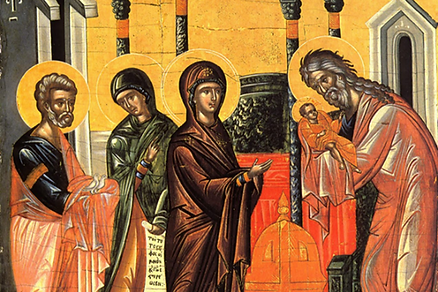
Moved by the Spirit
So we started off by talking about encounters with strangers, recognizing Christ even though we don't necessarily have any religious background. And then, we talked about the temple, that the glory of God is not a big thing, it's a tiny little spark inside of all of us. And then we talked about encountering strangers along the way, that even Mary had to make this choice when she was confronted with this stranger as did Abraham and Sarah. And then we talked about the purchase, about how it seems God has taken our yes for granted. But we're not finished yet. We still have first born children that we have to let go of and give to God so God can give them back to us.
So now we're gonna spend some time with Simeon and Anna in the temple. I want to think a little bit in terms of wisdom because, wisdom is what they bring to us, and wisdom is uncommon because our culture is filled with occupation with data, information, and it's just filled with information, all statistics, all that sort of world, and we mistake that for wisdom.
And, sometimes it's not easy to describe what wisdom is, but I remember some years ago, I was on a when I was much younger, I could I was invited to go on a horse trip with a couple of cowboy friends of mine. And so we had these two pack horses, and they had trees on them, two trees back to back, and they would hang these packs on these horses.
And they'd included tents and pegs and a stove and food and coffee and beans and fishing stuff and all this sort of stuff. I didn't pay much attention to what was going on when we left, but when it was time to come home, it was kind of a drizzly day out, I was impatient to get home. And these two cowboys, they had these packs, and they're big canvas sacks, so they would pick them up. He would pick them up like this, I'm going to this, and then he'd turn around like this, and he'd pick them up again, and then he'd pick them up like this, and then he'd take a can of beans out of this one and put it over in this one, and then he'd try it again, pick them up again and put them down. And then he'd say to, George, 'George, you try it.'
And the other guy, coming already, he'd come over. He'd pick him up, and then he'd turn around. He'd he'd pick him up again, and then he'd come back and he'd take a tea, a little box of tea and move from that one back there. And he he said, and I'm watching this show and thinking, 'let's get on with this, boys. It's wet out, it's cold.'
And, and they said to me, 'Tim -they said- if we don't get this right, we're gonna have a rodeo, and we'll be picking cans of peanut butter and toast and coffee out of the river. Because if that animal senses that those packs are uneven, he's gonna start to get restless. And the next thing you know, he's gonna try and even him out. The next thing you know, he's gonna give a kick because he doesn't like that pack over here, and it'll all be all over the place.'
It was a wonderful illustration because you can't learn that in a book.
You know? Those men had learned that by going on trips, on horse trips over and over. They learned it from life's experience. And that's, I think, part of what is supposed to be happening to us. As we come to this point in our life, as we get older and more frail, and realize that everything that could be lost is going to be lost.
That's what's going to happen to us. And I've been going through some of this myself with this hip of mine, and I got a phone call yesterday from the pain clinic in Lethbridge saying they can give me a cortisone shot in this hip, and maybe that'll help us. If you told me two years ago I would be delighted to hear from the pain clinic, I would have laughed and said, 'Oh, don't be ridiculous.' But I am quite humbled now by the fact that I am becoming more frail. I almost had to say to Sister Josephine at the airport, 'Would you please slow down?' Because Sister Josephine is a quick walker, and I couldn't quite keep up to her.
It's very humbling to come to that point in our life and realize I'm getting older and I'm more frail and I'm gonna die. And we have along with that a lot of anxiety and fear about that. What's that going to be like when I'm more frail? What's that gonna be like when I need help to get from my room?
What's it gonna be like when someone else has to feed me? Am I gonna be a burden to the community? Am I gonna be burden? Are they gonna wish I wasn't here? Is anybody gonna bother with me?
Are they even gonna come to my room? Are they gonna reach out to me?
All of those questions, I think, haunt us when we come to that point in our life and say, I don't just wanna get old, I want to become wise. I want to mature. I went to get my driver's license renewed when I was 75, and the woman at the registry thing, she said, 'Oh, you're 75, we're gonna give you the wisdom discount.'
And I said to her, I said, 'I've never heard that before. I love that.' I said, 'I'm gonna ask for that everywhere. I'm gonna ask for the wisdom discount. Even though I may not be wise, I'm still gonna go and see if I can get the wisdom discount.'
So what's that like? Because what we hear when we meet Simeon and Anna is that they're still sensitive. We hear this lovely line in Luke's Gospel, 'moved by the Spirit.' Moved by the Spirit, they went to the temple. So they're still sensitive to the sensitive.
And to understand that, we have to appreciate what it's like to be insensitive, to be desensitized.
Because we live in a culture and we're bombarded all the time by noise and music and sound and lights and fast activity in fast cars. After a while, it sort of numbs us. You get numbed down because there's so much noise going on, so much activity going on. And then we are starting to lose some of our senses.
I can't hear. I can't hear anymore. You know? And then we're starting to peer. And, you know, I remember going through this when I had cataracts.
It's hard to see. I can't see anymore. Can't hear. I can't walk as much. And so we also are experiencing this business of losing our senses.
And its much quicker, we are way quicker to notice when our senses begin to fail. Our physical senses. I might not accept it. Like I said, I didn't want to say to Sister Josephine, 'Slow down.' I just didn't want to be humbled and have to admit that I can't do that anymore, or I can't hear.
I remember one of our priests for years, he would go around like this. You know, and we kept wanting to say, 'Father, I think it's time for a hearing aid', but oh no, he didn't wanna do that. So he was cupping his ear trying to hear. So we're in denial about that. But I think we can also become desensitized to the spiritual life as well.
And part of it is because we live in a culture that's preoccupied with being young and vital and the physical world, we can lose sight of the spiritual world inside of us. Our spiritual senses can also be become numb a little bit. What does that look like? And are there some signs that we could have in our lives that might help us to become aware that I'm becoming a little numb, I'm becoming a little desensitized interiorly? Well, one of the signs of that is that we like being comfortable.
I like things a certain way. I like to sit in a certain place. I like to have a certain kind of food. I like a certain kind of routine. And I don't like my routines and the things that make me comfortable taken away or dislodged.
So we need to monitor that and pay attention to that. Am I insisting on being comfortable? Am I insisting on doing things a certain way? Because it's a sign that I'm becoming insensitive to others around me.
Another sign that we're losing our sense of being sensitive to the spiritual things. We lose our sense of compassion. We become more impatient. And we are not able to recognize compassion when we see it in other people. When we see people being compassionate, we don't respond empathetically to that, we respond critically to that. And we can almost be dismissive of their activity. 'Oh, don't pay them that kind of attention. It's their fault. Don't be like that.'
So it's almost like we fail to recognize when someone else is being compassionate.
Another sign that we're becoming a little desensitized to that spiritual dimension is we become less clear to us what's the goodness of God and what's evil.
We become that could slip away from us. And we start to dismiss small things in our life as, 'Oh, that doesn't matter. It's just a little thing.' And say, 'No, it's not a big thing. It's just a little thing.'
My criticism, or my comment, or my failure to help, or my dismissive attitude, or I don't reply to someone who greets me or something like that. Well, it's just nothing. You know, that's part of that. And along with this, what can happen to us is we lose the tenderness that makes community life possible. Community life, because people are living together, we're bumping into each other.
And it's irritating, and we don't often have the shock absorbers we had when we were younger. And so living in a community like you do requires a certain tenderness toward each other, a willingness to allow each other to be, make mistakes and not to be perfect. But we can lose that tenderness, that gentleness, and replace it with a certain, a kind of a critical attitude, a critical spirit.
So we have this wonderful pair, Simeon and Anna, who present themselves in Luke's Gospel as a wonderful model for what it means to be a wise person, and what it means to be sensitive. Because they have been preparing, it's quite clear in Luke's Gospel, to have this final encounter with God for years.
We talk about Anna's eighty four years old, Simeon's prophet been waiting a long time. These two have been preparing to have this final encounter with God, and by accepting their frailty, their own weaknesses, that has made them capable of recognizing God when God appears to them. Instead of being a weakness, they've turned it into a strength. Their frailty has opened their eyes so that they can recognize God who comes in the surprising form of a child, of a baby. Completely unexpected.
The last thing in the world you would ever expected was that that baby would be the face of God. That baby is an incarnation of God. Somehow their own frailty has made them aware of that, and allowed them to be prepared to welcome God who has come in a completely unexpected way into their life. And that's the challenge for all of us as we get older, is my frailty sensitizing me so that I can see in the frailty of others the surprising presence of God. That I can see in other people who, like me or somebody I'd overlooked before, I'd never paid attention to, and suddenly I see in them, they are an incarnation of God.
And they are calling forth from me something. They're asking something from me. They're asking me to give them something. So when we talk about this journey that we're on, this human journey that we're on, we spend the first part of our life kind of building up our life. Being active, being in charge, creating things, building things, working on teams, working in the parishes, working in hospitals, working in community centers, whatever it is.
And then once we've developed all these skills, we give ourselves away in those jobs. We give ourselves away to people. And you women have been doing this for all your life, giving yourself away in service to parishes, hospitals, community groups, you've been giving yourself away. And then we come to this point in our life, and now we have to give our death away. That's a real mysterious thing to say, 'I've come this far, I've given my life away, now I have to give my death away.'
And what does that mean to give our death away finally? To surrender ourselves finally to God. So one of the writers that I've been drawn to, and it's this French priest Teilhard de Chardin, who is a paleontologist and was involved in all these digs, archaeological digs to uncover the human journey and skulls and fragments and all of that. He does some wonderful meditations on on this aspect of life. So at one point, he's on a dig in China, and he's all by himself out in the mountains somewhere.
And it's Easter Sunday, he's out there, and he has no bread, no wine, no altar. But he offers a mass on the world, and he writes it out. It's a it's a wonderful prayer, Mass on the world. And I've often used it myself in addition to the Mass when I'm praying by myself, but he has two moments in it that I think are quite profound. He said, and they're this, he said, Over everything that is to come to birth today, over every new spark of life, every new blade of grass, every bird that, every chick that is born, every human being that's born, every person who sets out on a new adventure filled with energy and joy, speak your words, 'This is my body.' Over every new life in the world today.
And then he says, And over everything that is to die today, every animal that dies, every fish that dies, every plant that dies, every human being that dies, every person who suddenly becomes weak and frail, Speak your words.' This is my blood.' Wonderful. Wonderful.
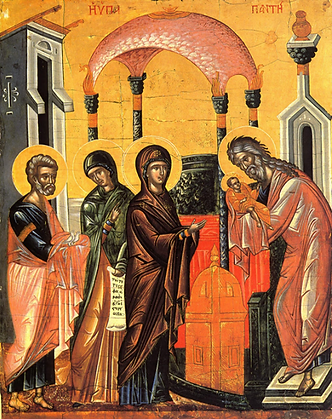
To come to that point in life and to look at everything that's brand new and to say, This is my body, and everything that's dying saying, This is my blood. That that's our offering. And then he has this wonderful prayer, and it is here below along with those icon of Simeon and Anna on moved by the Spirit.
So just to have a quick little peek at the icon, we have Joseph on the left holding the two doves, and then next to Joseph is Anna, and Anna is a prophetess. That's why she's always pictured, often pictured with a scroll, because she's a prophet.
And then we have Simeon on the right holding the child, and Mary in the center. A lovely image of the presentation in the temple.
And then here we have Teilhard's prayer.
When the signs of age begin to mark my body (and still more when they touch my mind); when the illness that is to diminish me or carry me off strikes from without or is born within me; when the painful moment comes in which I suddenly awaken to the fact that I am ill or growing old; and above all at that last moment when I feel I am losing hold of myself and am absolutely passive within the hands of the great unknown forces that have formed me; in all those dark moments, O God, grant that I may understand that it is You who are painfully parting the fibres of my being in order to penetrate to the very marrow of my substance and bear me away within Yourself.
Lovely prayer. Because De Chardin had this deep confidence that he was part of the work of creation. That creation wasn't separate from him. That he was part of this work of creation. That God after his death, he would continue to be part of this mysterious work of creation, because he would be sharing in the consciousness that God had placed in creation, that was going to continue to bring creation to its final destiny, when all would be one in Christ.
And I find that's a very helpful way of talking to my own nephews and nieces about heaven. Because some of them grew up with that understanding, that concept of going to heaven, but it's kind of foreign language to them. But I will say to them, 'Do you have a sense that you share in deep awareness of the world around us?' And this consciousness is something that they believe they can even detect in that world out there. That they have a sense that they can be, when they're in nature, that nature's communing with them. That trees speak. Water speaks. Not as sophisticated as human beings, but there's a consciousness that's part of creation.
And this consciousness, this is Teilhard's gift of the church, we weren't very quick to accept it, but this consciousness is driving creation forward. This consciousness created by God is lifting creation up, bringing it forward, helping it to develop, until finally Christ will be all in all. So, I think Teilhard believed that when he died, he would become part of this consciousness that's lifting creation towards its fulfillment, and bringing all of creation to that point. Do I need to call that heaven? If it helps.
But I can call it a consciousness in the world that when I die, I hope I'm part of it. And I hope I've lived my life in such a way that my deep desire is for community. My deep desire is for oneness. So my consciousness, if that's my deepest desire, is gonna be on the side of Sophia, on the side of the Holy Spirit, continuing to bring creation to its completion. And alongside of me will be all the saints who shared in that deep desire for community and for oneness.
And I don't have to worry about losing anybody, I don't have to worry about as long as that was the side they took. Instead of being on the side of tearing things down, if you took the side of building things up, you're going to be on this side, moving towards the fullness of creation. I love that image because it's helpful in my conversations with my own nephews and nieces about the future, and it gives us some, a way of sharing our confidence in the future with one another in language that isn't off putting to them.
So is that a little helpful for you? You might find yourself awkward stumbling about that, but I found it was really helpful to them to talk about the consciousness of the world, and ask them, 'do you believe the world is sort of self conscious? Do you believe the world has some of the same self consciousness that we do?' I get lots of nods. They'll say, 'Yep, I do.' I say, 'So do I.'
So do the Saints. You know? And we're all part of that. And when we die, we're gonna be part of that too. We're gonna be part of this ongoing consciousness that's finally leading us to that point where Christ is all in all.
Enough for today. So let's listen again and sing that prayer about turning to God and being saved.
Midwives to the next generation
Singing...
Rejoice in the lord, oh you righteous. Praise benefits the upright. Praise the lord with a lyre. Make melody to him with a harp of 10 strings. Sing to him a new song.
Play skillfully on the strings with loud shouts. For the word of the lord is upright and all his work is done in faithfulness. He loves righteousness and justice. The earth is full of the steadfast love of the lord. By the word of the lord, the heavens were made and all their hosts by the breath of his mouth.
He gathered the waters of the sea as in a bottle. He puts the deeps in storehouses. Lord, let your mercy be on us us as we place our trust in you. Lord, let your mercy be on us Let all the earth fear the lord. Let all Lord, let your mercy be on us as we place our trust in you.
Lord, let your mercy be on us as we place our trust in you. The Lord brings the council of the nations to nothing. He frustrates the plans of the peoples. The council of the Lord stands forever. The thoughts of his heart to all generations.
Happy is the nation whose God is the Lord. The people whom he has chosen as his heritage. Lord, let your mercy be on us as we place our trust in you. Lord, have your mercy be on us The Lord looks down from heaven. He sees all humankind.
From where he sits enthroned, he watches all the inhabitants of the earth, he who fashions the hearts of them all and observes all their deeds. Lord, have your mercy be on us as we place our trust in you. Lord, let your mercy be on us as we place our trust in you. Truly, the eyes of the Lord is on those who fear him, on those who hope in his steadfast love, to deliver their souls from death and to keep them alive in famine. Lord, let your mercy be on us as we place our trust in you.
Trust in you. Our soul waits for the Lord. He is our help and our shield. Our heart is glad in him because he trusts in his holy name. Let your steadfast love, oh lord, be upon us even as we hope in you.
Lord, let your mercy be on us as we place our trust in you. Lord, let your mercy be ours as we place our trust in you.
I hope the images have been helpful. I love that image of Mary encountering the angel and she's kind of half pulling away and half with all of that reflection about. And I love that painting of Mary with these deer doves of hers. She's already said yes. She's accepted the child and now she has to let something else go. You know, we have to let something else go that is dear to us, our firstborn.
And then we've been meeting these two wisdom people in the temple, Simeon and Anna, who I I quite I quite love these two. We talked about how despite their age, they were still sensitive, moved by the Spirit, sensitive to the Spirit. And in fact, their frailty, their weakness had disposed them to be able to recognize Christ in frailty, in weakness, in a baby. So instead of it being a handicap, their frailty was an opening to recognize the hidden presence of Christ in the world.
So we're gonna reflect a little bit today about, I've called it midwives to the next generation.
We take some of these things for granted, but I think it's important to call them to mind from time to time. And one is that every atom in our body, except for helium and hydrogen, came from the death of a star. We don't often think about that, but that's the reality. Every atom in our body except for helium and hydrogen came from a star that gave up its life for us. Our red blood is there because of iron.
And iron was created by the death of a billion stars, which eventually ended up on part of this planet Earth. So we are an inheritance, physically. We are who we are because of the unfolding mystery of creation that's brought us to this point. One of our catechists was showing me how they teach the story of creation to children, and it's a lovely illustration. They have a spindle, and the spindle has this ribbon all around it.
And so they start to unwind the ribbon, and the very beginning of the ribbon says, 'The great explosion caused by God thirteen billion years ago.' And then they start to unravel this ribbon, you know. And you know, ten billion years ago, 18,000 galaxies have been formed. And the ribbon gets longer and longer and longer. And then finally six billion years ago, the planet Earth is formed. You know, it goes on and on. And sixty thousand years ago, the first human beings walked on the planet. And the ribbon is getting shorter now because of the comparison of time, right? The first ten billion years took 10 yards. Well, sixty thousand years only takes five inches.
And then you come to this point where the Incarnation and the birth of Jesus and his death and resurrection, it takes about that much space on the ribbon. And then the ribbon is a colored ribbon with all of the sun. And then the next section of the ribbon is blank. It's white. And the teacher is able to say to the students, 'Now that's the story that you have to write.'
That's your job now, is to write the next chapter in the story of creation that goes all the way back to the first moment that God imagined the universe into existence. Lovely tool, I thought. What do I know, right? So I said to her, 'Can we do this with the priests at the Sunday days?' So she agreed.
So I came up, so we did this with 80 priests in a study hall. And afterwards I was at the priest council meeting, I said, 'Well father, what did you think of that?' 'Oh that's irrelevant. We're Crist-centric, father Tim. We only care what happened after Jesus is born and suffered and died. We don't care about all that other stuff.'
I thought, 'Isn't that sad?' As if God doesn't care about thirteen billion years, you know. I keep thinking, 'No, that's really important. That's how we got to be here, that whole story.'
So I keep pushing that and saying, 'Yes, that's part of the story, part of our lovely story.'
So we're an inheritance of the universe. We're an inheritance of creation. And we're also an inheritance of our own family history. One of the wonderful gifts that Pope Francis has given to us is the Feast of Grandparents.
I love this, you know, to acknowledge that we're children because we have grandparents. And our grandparents, for most of us, they caressed us with love, and they helped to set us off in this journey. They gave us that first caress of love, which only grandparents can do because they're not burdened with having to raise us. Right? They can love us unconditionally, don't have to put up with us.
At the end of the day, they can give us back to our parents. But when they are in our company, they could caress us with love and we learned that this caress of love that comes to us from history, that's what roots us. That's what gives us our stability. That's what gives us the confidence of who we are. And Pope Francis is fond of saying, 'Now we have to be artisans of a new history.'
We have to write a new history. Weavers of a new history, he called it. And he's very, he's been, he was very firm about saying, 'Don't get stuck in the past.' Yes it's wonderful. And yes those things were beautiful to us.
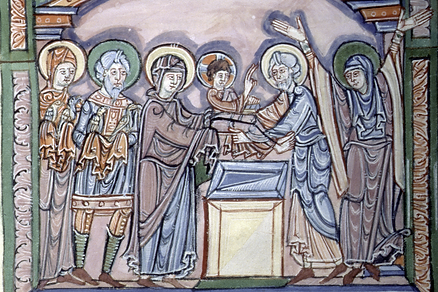
But you can't let the past imprison the future. You can't just say, everything that went on was perfect and we've gotta hang onto it, because he says, if we do that, we end up being rigid and critical and self centered and narrow and focused only on ourselves. I think one of his gifts to us was that acknowledgement of this caress that comes to us from the past, but also his encouragement to say we have to be weavers of a new history, artisans of a new history. And I think that's the wonderful gift that, Simeon and Anna give to us, you know. So we have this lovely icon in our booklets here on a presentation scene that comes from a sacramentary in Normandy, ten fifty.
I love this image of this because it's so unusual in how particularly Anna is depicted in this image, you know. Here's Anna, you know. Its a lovely image. She's rejoicing. She's got her arms up in the air.
She's filled with joy at what's happening in front of her. And she's telling everybody about it, you know, 'Look there.' She told, Luke tells us, she told everyone she met, you know, about what was happening in there. You can imagine this 84 year old in the temple, tugging people on the corners and saying, 'Look there, look there, that's Christ.'
Look there, that's God is here among us. Look there, God has come again. God is in our midst. You know, what a wonderful example for us as wisdom people, is this example of Anna proclaiming this wonderful message to everyone she meets and it's full of joy. You don't get a picture in here of Anna being attached to the past. You don't get a picture of her clinging to the past. You don't get, you don't see somebody's got a sour look on her face saying, oh, 'I wish things were the way they were in the good old days.'
You know, that's not the picture you have here of this woman, Anna. You have this lovely picture of her filled with joy, wanting to share this good news with everyone else, wanting to proclaim it, not attached to the past. You know, over the last, years, we we, I think, have come to recognize that Mary Magdalene as the apostle to the apostles. You probably heard that in some of your study things, how she was the first messenger of the good news of the resurrection to the apostles. She went and proclaimed what Christ had revealed to her. But Anna's the prophet of the incarnation. She's the one who proclaims the incarnation to everyone. So we have these two wonderful women.
We have Anna as the proclaimer of the incarnation, the presence of Christ in a new way to a new generation. And then we have Mary Magdalene as the proclaimer of the resurrection to the apostles, to the church. But I love this image of Anna as an announcer of the incarnation, the woman who's filled with joy. So how does that come about? How is it that these two and their elders, she's 84, Simeon we can assume is of the same generation, how is it that they have been so transformed?
Well I think we get a little indication even from the icon of what's going on. Because in this icon, we almost can imagine Mary offering the child to Simeon, and inviting him to hold the child. And occasionally that has happened to me and I think hopefully it sometimes happened to you where a nephew or a niece or somebody in the community comes to the new baby and they say to us, 'Would you like to hold them?' You know? That's a magical moment, you know?
Just, 'Would you like to hold them?' And it reminds us of the power of a child, you know. If you put a movie star in a room, you know, these big singers, Taylor Swift in a room and you put a five star general of the US army in a room and you put a baby in the room, which is the most powerful? You know, it's not Taylor Swift. And it's not the general, it's the baby.
Everybody wants to hold the baby, and everybody wants to protect the baby, and they want to shelter the baby. And you know something else? They want to behave well in front of the baby. 'No, don't do that. The children are watching', you know.
We have that instinct in us that children draw forth from us. This instinct. And I think that's part of what's going on in this wonderful encounter in there, is Simeon holds the child, and if you've held the baby in your arms and the baby is awake, the baby's looking at you, you know. And I think part of our growth in spirituality is we have to have an imagination. I know Ignatius was great about this.
We have to imagine some of these scenes. And one of the things I think we have to imagine is we have to imagine holding the baby Jesus in the temple and have him look at us. And imagine this baby Jesus Christ, looking up at us. What does that baby Jesus see in us? Because a child looks beyond appearances, a child looks beyond our history. It doesn't see our mistakes. It doesn't see the things we did wrong or we failed. It just looks on us with love, and beholds us with love, and sees only that goodness in us that's created by God. That's what children see in us. They see beyond everything else, and they see the goodness and the innocence and the love that God created in us.
So to some extent we have to be in this story. We have to be Anna in the story. We have to be Simeon in the story. And imagine that this child has been presented to us, and we've been invited to say, 'Would you like to hold Him?' You know, because if we don't hold Christ, and we can't imagine ourselves holding Christ and having Him look at us, what are we gonna hold? You know?
You know, we can hold things, we can hold accumulate possessions, but if that's all we hold, then we are, we will become narrow and rigid and complaining and self centered. But if we're holding Christ in our arms, we're going to be gentle, and we're going to be loving, and we're going to be forgiving, because that's what children draw forth from us, and that's what Christ draws forth from everyone. Draws all of those virtues forth from us if we allow them to take place in us. And the consequence of that for Simeon and Anna is that we should become, and this is what happens to both of them, poets of a new song.
Anna tells everyone in the temple what she has seen, what she's heard. Simeon becomes a poet, 'now Lord you may dismiss your servant in peace.' He writes this lovely, lovely song. Never a poet before, but now he's a poet. Now he's singing a new song, a new creation.
And I think that's our invitation as a retreat is, can we become poets, singers of a new song? And I think in some ways, that's what this meditation from Thurman is about. She's a theologian and a mystic who died many years ago. But I left this poem because in some ways it captures what needs to take place in all of us.
The old song of my spirit has wearied itself out. It was long ago learned by heart so that now it repeats itself over and over, bringing no added joy to my days. It is a good song, measured to a rhythm to which I am bound by ties of habit. The words belong to old experiences which once sprang fresh as water from a mountain crevice fed by melting snows. But my life has passed beyond to other levels where the old song is meaningless. I know that the work of the old song, perfect in its place, is not for the new demand! As difficult as it is, I must learn a new song that is capable of meeting the new need. I must fashion new words born of all the new growth of my life, my mind and my spirit. I must prepare for new melodies that have never been mine before. How I love the old familiarity of the wearied melody—how I shrink from the harsh discords of the new untried harmonies. Teach me, Father, that I might learn with the abandonment and enthusiasm of Jesus, the fresh new accent, the untried melody, to meet the need of the untried morrow. May I rejoice with each new day and delight my spirit in each fresh unfolding as I sing, this day, a new song to you my God.
Think in some ways those could be the words of Simeon and Anna in the temple. They've sung a song for a long time and now they're faced with a new discovery, a new presence of Christ as we all experience over and over again. Christ is always coming to us in a new way.
It always means learning a new melody, singing a new song, and being like this wonderful woman of joy, wanting to tell everyone she meets of what has taken place in her life and in the life of the church.
So, I hope you can on this beautiful day imagine holding the child Jesus in your arms and him looking up at you with love and seeing the goodness and beauty in you and feel your heart soften with love.
So we'll finish by singing that lovely refrain about God's mercy coming upon us. Lord, let your mercy be on us as we place our trust in you.


Sword of sorrow
Singing...
To you, oh Lord, I offer my prayer. In you, my God, I trust. Teach me your ways, oh Lord. Make them known to me. Teach me to live according to your truth for you are my God who saves me.
Remember, oh Lord, your kindness and constant love which you have shown from long ago. Forgive the sins and errors of my youth. In your constant love and goodness, remember me, Lord. Because the Lord is righteous and good, he teaches sinners the path they should follow. He leads the humble in the right way and teaches them his will.
With faithfulness and love, he leads all who keep his covenant and obey his commands. The Lord is the friend of those who obey him and he affirms his covenant with them. I look to the Lord for help at all times and he rescues me from danger. Turn to me, Lord, and be merciful to me because I am lonely and weak. Relieve me of my worries and save me from all my troubles.
Protect me and save me. Keep me from defeat. I come to you for safety. May my goodness and honesty preserve me because I trust in you. From all their troubles, O God, save your people Israel.
To you, oh Lord, I offer my prayer. In you, my God, I trust. Remember, oh Lord, your kindness and constant love, which you have shown from long ago.
Thank you. Lovely Psalm, isn't it? Lovely Psalm.
And I get the singular joy of introducing you to this remarkable woman. One of the reasons why we don't hear about her, haven't heard about her, is she's an Orthodox saint, and we don't talk to those people, so it's really tragic. She was named the patron saint of Paris in 2015. So I'll give you her biography because it's really quite an extraordinary story.
So she's growing up in the 1920s in Russia. She's a member of a devout Russian Orthodox family. The Bolshevik Revolution takes place, and she gets caught up in it because she has this heart for the poor, and heart for those who are being mistreated by the czar, and by imperial Russia. She marries badly and is divorced. A child she had in that marriage goes off to live with an extended family.
She's the mayor of her village in Russia. She's arrested. She's sentenced to death for participating in the Bolshevik revolution. She manages to get out of jail and she ends up marrying the judge who pardons her. So, she is married, she is divorced, she's married again.
And now this is, she's in 1930s, all of that turmoil that's going on in Europe. She and her husband go to Paris to look after the emigres who fled there from Russia to escape the pogrom that's going on in Russia. At the same time as Nazi Germany invades France. So here she is, she's looking at the soup kitchen in Russia, caring for it, and scrambling to find food, looking after all these people who have come, many of whom are Jews, who showed up at this, at her soup kitchen, at her hostel in Paris. She divorces again.
Her husband leaves her. She's left in Paris with her daughter Anastasia. She recovers her Orthodox faith, and she petitions the patriarch to become a nun. So she becomes a religious. Complete with a habit, black habit, here she is in Paris, France, and they have stories of her sitting outside cafes in France, smoking a cigarette, drinking a cup of beer, because she's going around scrambling for food, for her soup kitchen, and for her hostel from anywhere she can get it.
Quite an intimidating woman. The Nazis invade and take over Paris, and she is deeply offended by what's going on. In fact, because they've singled out the Jews and asked them to wear this yellow star. Mother Maria says, we should all be wearing the yellow star in solidarity with this people. So it's nineteen forties, '41, '42, they're rounding up the Jews and taking them to the concentration camps to be exterminated.
And in Paris, they've herded them all together into a soccer stadium. Tracked them all down, herded them in there prior to them being deported. Mother Maria is quite well known in Paris, her habit, and because of her ministry among the poor, so she is allowed to venture into this soccer stadium to bring food, and whatever comfort she can offer there. And she comes up with a plan to have the Jewish parents put their children into garbage cans, so she can export them out of the stadium. So she's taking these children in garbage cans out of the stadium to rescue them from what's coming.
Anastasia gets sick, her daughter, and dies, and it's heartbreaking for mother Maria, and proves to be a singular contribution to her faith. And then finally, nineteen forty four, nineteen, the war is coming again. She's arrested. She, along with the Jewish people she's been ministering to, go to Ravenswood, where she's executed. Amazing story, you know.
Lovely story. Her writing, she did some writing, and she has, they had some memories. And one of the memories is of this icon. So that's the icon of mother Maria, and she's holding an icon of Mary in her hands. And this, the people in the camp remember her drawing this icon, shaping this icon.
It's Mary holding the crucified Christ in her arms. Quite a striking picture. So we have sort of two icons in this picture. The icon of Mary of Paris, Mother Marie of Paris, then the icon of Mary holding the crucified Christ in her arms. So what, how can we best describe her insight into the Christian life?
And you gotta keep in mind though, this is nineteen thirties and forties she's writing this stuff. She's become alert to how individualized the Western world is becoming in our thinking. How we're seeing ourselves so much as individuals. And this is nineteen thirty and forty. Imagine what she'd think if she was in 2020, how individual. But this is back then, so she has this insight that we're becoming very, very individual in our thinking.
And she makes a comparison between what she calls the unsanctified ego and the sanctified ego. What she means by the unsanctified is the not baptized person, and the sanctified is the baptized person. And she says, there's almost no difference between the two. She said, the unsanctified person sees the world out there as a place for me to go out and do whatever I want with creation to satisfy my ego.
She said the sanctified person, and these are, she's looking at Christians, sees the world out there as an opportunity for me to go out and do good deeds so that I can make myself into a good person. She says, there's no difference in here. She says, the root of sin is to see ourselves as an isolated person, who is trying to create a relationship to Jesus Christ, who we see as another isolated person.
And our goal is to imitate Jesus Christ as one isolated person, imitating another isolated person. And she says, this is rootless life, Because it means our whole life is growing out of our desire to make ourselves into a good person out of our own energy, out of our own image we have of ourselves as a good person.
I'm going to go and do good deeds. So one of the images she said, we fancy ourselves to be like a hero or a heroine, venturing out of our castle of our ego, out onto the streets of Antigonish to go and do something good for God. And then we bring it back into our ego and we offer it to God as a little gift, a little treasure all wrapped up. She said, she said, and she said, and somehow we justify this because I chose to do it.
I made a free choice to serve meals on wheels. Or I made a free choice to visit the sick, or I made a free choice to go to the jail. Because I chose it, she said, we have this crazy idea that somehow it's of more value. As if somehow my choice of it elevates it to some kind of new status. But it's this image she has of us as heroes and heroines leaving the castle of our ego to go out into the world, fashion a good deed, bring it back into our castle and offer it there to God in imitation of Jesus expecting some kind of reward. So what's her alternative?
Well her alternative, she says, is the cross. And she says, we have to both imitate Christ and imitate Mary, and we have to understand the differences and the complementariness of their two vocations. So at the cross she says the cross and the sword, remember Simeon's language about the sword of sorrow will pierce your heart. Mother Maria sees that both of those are present at the cross. She says Mary doesn't suffer for Christ.
She suffers with Christ. Christ is crucified. Mary is co-crucified. Christ suffers, Mary co-suffers. Christ shows us the meaning of passion. Mary shows us the meaning of compassion.
She says, historically we tend to look at the cross as an involuntary thing that happens to Jesus, and the sword of sorrow was something that Mary participates in willingly. Mother Maria says, nope, we got it mixed up. That's backwards. She said, the cross is something Christ voluntarily accepted. He chose that. Mary did not choose her suffering. Mary's suffering is involuntary. It is thrust upon her. And some of this she's come to as she is reflecting on the death of Anastasia.
Because the death of her daughter Anastasia has challenged her own understanding of how she sees herself as a mother. As she's preparing for Anastasia's birth, she's in a sense preparing a space for Anastasia to live in, even prior to Anastasia being born. It's kind of like painting the nursery, you know. I prepared this room. I made sacrifices to get the room ready. I bought stuff for the room. I did all of these things so that when Anastasia comes she'll have a place and I created the place and it's going to reflect well on me. It's going to show everybody what a good mother I am. Look what I did in preparation for my child. And then Anastasia is taken away from her.
And Mother Maria realizes she had to sacrifice her sacrifice, if that makes sense. So she'd made a sacrifice to get ready for Anastasia and now she has to let the sacrifice go. She has no choice because Anastasia is gone, so is her sacrifice gone. She's caught up in this suffering and she goes, suffers along with Anastasia because Anastasia is her own flesh. And she said that's the key in faith we need to acquire about Mary.
Mary suffers with Christ because that's Mary's body on the cross. Mary created that body. That's her flesh and blood, that suffering. She gave that body tissue in her womb. That body is her flesh and blood.
So Mary is drawn into the suffering of Christ whether she wants to or not, because she and that body are one. They're tied together. And then Mother Maria makes this leap. She says, If you've been baptized, you and the body of Christ share the same flesh. You and the body of Christ are one flesh.
She said, This is not an idea. This is not some spiritual concept. This is reality. You and the body of Christ are one body, one flesh. And the body of Christ participates in the sufferings of all human beings.
So if you are a baptized member in the body of Christ, you have no choice but to participate in the sufferings of the world, because that's where the body of Christ is experiencing the sufferings of the world. Do you get a little sense about that? About how she, so in some ways she's way ahead of her time because quantum physics now tells us that the atoms in our body are all connected to the atoms of everybody else's body. We're not a discreet We're not made up of discreet separate particles that are only identified with me. We're part of everything now.
Here's mother Maria in 1930 saying, I'm part of the body of Christ and I'm part of his physical body and his body incorporates all the sufferings of the world. So if I'm part of his body, the only option I have is to opt out. Is to refuse to be engaged in the sufferings of the world. That's the that's the only choice. I am part of the sufferings of the world.
I can deny it or I can participate in it. I can accept this role or I can flee from it and do everything I can to escape from it. I think it's an amazing insight way ahead of her time. And she goes on to say that the only real way for that to happen to us is for us to be overwhelmed. To have our nice neat and tidy ego annihilated.
To be invaded in a sense. To be overwhelmed so that we can't, we can't choose. It's too much. It's everywhere. It's all around us.
The suffering is all over. It's like a wave hitting us. A tsunami hitting us. Only when that happens is my ego finally crushed. And I finally have to say, 'Lord, do whatever you want with me. I can't run away anymore. I can't escape this.'
She she says, anytime we can manage to create a program, she said we're failing to recognize the reality. By a program she means, well our program managed to feed sixty two percent of the hungry people in Antigonish. She said no no no no, it's all or nothing.
It's all or nothing. You can't go and say we did our best. Nope, it's all or nothing. And all that's coming out of her work with the immigrates in Paris and trying to feed them, trying to save these children, being responsible for everybody in that soccer stadium, not just some, but all of them in that soccer stadium are her responsibility. And so I have to in a sense allow myself to be annihilated by this overwhelming pain that comes from the world if my little eagle is finally going to be crushed.
That's why I gave you another picture in your book. Have you heard of this picture or seen this? Some of you might have. So this is a lovely Canadian story. So this is Pope Francis.
You know how deeply attached he was to the immigrants that were in the Mediterranean Ocean, etc. All of that. So he commissioned, he said, I want something in St. Peter's Square to serve as a permanent reminder of this reality and our day and age. So we had our Canadian Cardinal, Czerny, good man Czerny, to commission this work.
It's 30 feet long, and it has immigrants from every historical age and every culture jammed on this boat. And Czerny had it commissioned in bronze, and it's the first new piece of architecture to go in St. Peter's Square in four hundred years. A bit of Canadiana there for us. It's called Angels Among Us.
And can you see the angel wings sticking up above the crowd there? You see those two pointed things pointing up to the heavens? Angels among us. But in a sense, it's a visual reminder of what Mother Maria experienced as she's looking after the emigres in Paris in nineteen forties. Overwhelmed by the need.
Unable to meet all the need. But because she's participating with them and in them, her own ego has been destroyed and she's now one with the body of Christ. There's no difference between her and the body of Christ because of this willingness to be overwhelmed by the pain and suffering of the world. Towards the end of her life, she looked up and she said, we need to see every human being as an icon of God, decorating the halls of creation, and we need to venerate every person as an icon of God by our service, and our care and compassion. Lovely woman, we hopefully, we might hear more and more of her writings.
They're slowly being translated into English, but it's a lovely story, I think, and I think it's a great, it's kind of a complimentary story to Maximilian Kolbe, because that was the story we had of someone dying in the concentration camps. And here's another one, a richer one, a more profound story of this woman dying in the concentration camp. But after all this ministry, trying to rescue and to save the immigrants, the refugees in Paris prior to that awful death.
So I'm so pleased to be able to share that story with you, and you can kind of Mother Maria of Paris, what a lovely contribution she is to the saints among us who we continue to pray for and ask for their intercession. So let's finish with let's finish with another verse of that lovely song, Be with me, Lord, when I am in trouble.
Thank you.
